0

Published in Black Static

The new issue of Black Static is out, and contains my story Three-Legged Bird. This is the story that I read the first half of at WisCon during the Taboo reading–the one about sex trafficking of Korean girls.

Big thanks to Gord Sellar and his fiancee for helping me get the details right on Korean culture.

1

Clarion and Clarion West advice

People ask me a lot for advice on attending Clarion or Clarion West.

You can find all sorts of information online about how to write, how to manage your time, and general coping techniques. The welcome packet is full of great suggestions. But here’s my single best piece of advice.

Remember that you, and your classmates, will be under a ton of stress. Everyone reacts differently to that stress. Some panic. Some withdraw. Some cycle rapidly between highs and lows. Some overreact to the smallest slight. Some blurt out hurtful things without thinking.

Remember that many of your classmates are at their worst. You will see their ugly sides. The best thing you can do is forgive people their imperfections. I’m not saying you have to be a doormat, nor that you have to take abuse. I’m simply saying: Give people the benefit of the doubt. Assume the best of them. Shrug off the occasional personal conflict over something unimportant. Have faith that as the years pass, and you see them at conventions, you’ll get to know their real self even better. And you may be surprised at who you bond with and who you stay close to over the years.

I was lucky enough to like all my classmates. But there’s several I like even more now that I’ve gotten to know them in a more relaxed environment.

Good luck, everyone!

0

World Fantasy ahoy!

Just bought memberships, flights, and hotel for World Fantasy 2010. Woo!

And here’s a tip, thanks to msisolak. Southwest has _great_ prices into Columbus right now. I just bought round trip tickets from SFO for under $250 each. And at decent times, too. Get thee to the Southwest website!

0

Minis

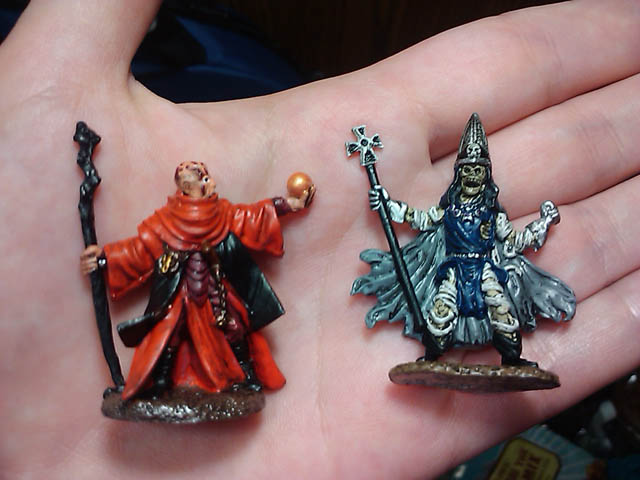
So I keep saying that I “paint minis” as a hobby. Minis are those little pewter figures used for tabletop games. They come unpainted, but you can paint them.

I’m still pretty new to the hobby. Turns out I have very focused eyesight and steady hands. Anyway, I thought I’d show two random minis so you could see my work. They’re on my hand so you can see the size. (I have smallish hands). Also, I fixed the smudge on the red wizard after I took this photo. (Minis are a great place to be perfectionist!)

ETA: picture size fixed.

minis-1

2

Writing process 1: Wordcount and length

Thought I’d make some posts about my personal writing process. No idea if this is interesting, but maybe it will be to some people. I’ll start with wordcount and length for short stories.

When I draft a short story, I write to whatever length it needs to be. Usually I know this after the first scene; I can estimate within 1k words what the length will be. That’s from experience; my estimates keep improving over time. It’s a useful skill. There’s no way to teach this. You just have to practice a lot.

I have three approximate lengths for my short stories, not counting flash fiction. Short = 2k-3k. Medium = 3.5k-4.5k. Long = 5k-6k. After the first scene is drafted, I generally know if the story will be short, medium, or long. My stories tend to cluster at the centerpoints of those ranges. 2.5k, 4k, and 5.5k. Scenes are usually 800-1200 words.

4k is the most common length for me. A few years ago, I averaged 5k. Then I dropped to 4.5k. Now I’m at 4k. The difference is that I’m telling the same stories in fewer words. My writing has become leaner, thanks in part to The 10% Solution by Ken Rand. (The webpage is a useful start–but I think serious writers should read the whole book.)

It also means that when I critique a story in a workshop, I can tell the writer, “I think you have only 4k worth of story here,” when they’ve written it in 6k. Or the less common, “You’ll need 7k to deal with this idea,” when they’ve written 3k. Most newer writers have too many words in proportion to their content. So it’s not bad to say “this is only a 4k idea.” Some ideas simply require more development than others. Like gemstones, ideas sparkle most in a properly-sized setting.

As for the actual writing–once I have an idea what I’m getting into, then I just write and don’t worry about the wordcount (aside from using it for motivation, like “I can stop when Word tells me I’ve hit 3k”). I am rarely wrong about the approximate length. Even if I have no idea what the events are, or how the story ends.

Next writing process topic: revisions. (Is there anything particular you’d like to know about my writing process? Tell me in comments.)

0

Looking for a certain fanfic policy

Dear Internet,

A while ago, I read a website where an author talked about her fanfic policy, as it relates to her books. I’m 90% sure it was a female fantasy writer, and a name I knew. I can’t recall who she is nor find her on Google.

The policy went approximately like this. She said: “Before you write fanfic of my work, I need you to download a form from my site, fill it out, and mail it to me.”

She had the form online to look at. It basically said, “Don’t make money from this, please give me credit for creating the world, and understand that I won’t read any of it (in order to protect myself).” Once a person sent her the form, they had free rein to write as much fanfic as they liked.

Does anyone know who this is, and can you help me find this page?

(Let’s refrain from discussing the actual policy until we find the page. My summary might be incomplete or inaccurate.)

Any help appreciated. Signal boost welcomed.

ETA: It’s not this one from Mercedes Lackey. The content is less of a contract, and more of a written confirmation that the fanfic writer understands the “rules”.